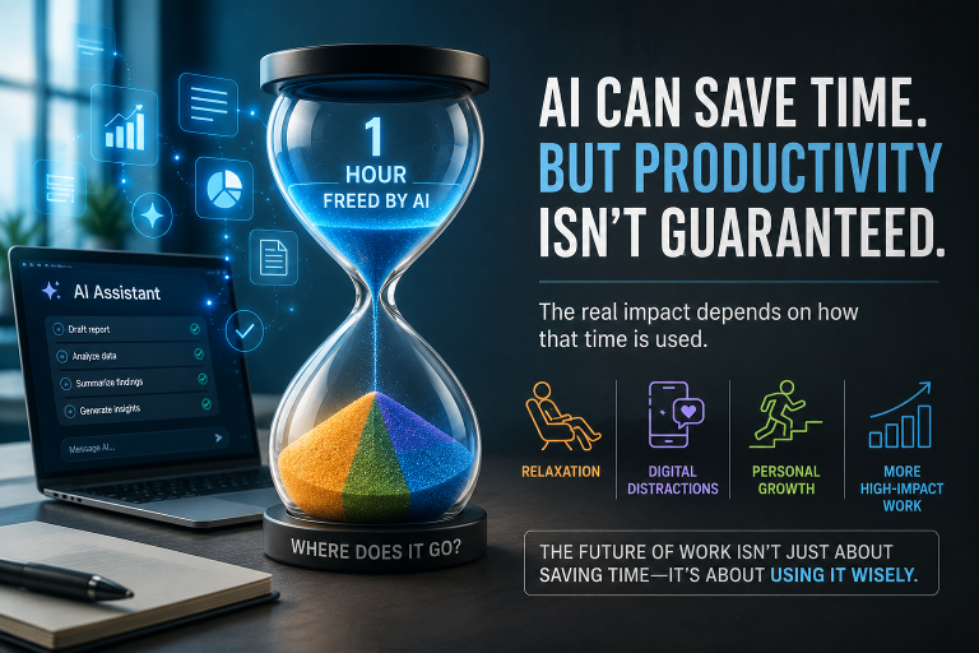
The Exoskeleton Fallacy: Why "AI That Augments People" Doesn't Automatically Buy You More Output
Abstract: AI is supposed to make employees more productive, not replace them—but that promise quietly assumes everyone is already at full capacity. Here's where the freed time actually goes.
Every enterprise AI strategy deck eventually arrives at the same reassuring slide. AI won't replace your people, it will augment them—an Iron Man exoskeleton bolted onto the workforce, turning ordinary employees into enhanced versions of themselves. It's a comforting story for boards, a defensible one for HR, and a flattering one for employees. It is also, on close inspection, built on an assumption that almost no one says out loud.
The exoskeleton metaphor only works if the human inside it is straining against a physical limit. A powered suit makes you stronger if you were already lifting as much as your muscles allow; it does nothing for output if you were standing still. Translated into organizational terms: augmenting a worker increases output only if that worker was previously output-constrained—running at full capacity, with a backlog of valuable work they couldn't get to. The entire augmentation thesis silently assumes that condition holds for everyone, everywhere, all the time.
It almost certainly does not. And once you relax that assumption, the central question changes. The interesting question is no longer "how much more can an augmented employee produce?" It is: when you hand someone back two hours of their week, what do they actually do with it? Take on more valuable work—or, as the skeptical version goes, play more golf and take longer lunches?
The honest answer, supported by a wave of 2025–2026 research, is uncomfortable for both the optimists and the cynics. Freed capacity does not reliably convert into output. But it does not reliably convert into leisure either. Where it goes is not a property of the technology—it is a property of how the work is designed and managed. The exoskeleton is real. What's missing is the mission.
Part I — The Buried Assumption: Most Knowledge Work Isn't Capacity-Constrained
Start with the premise the metaphor depends on. The augmentation narrative is now close to consensus among researchers and executives. MIT Sloan's widely cited 2025 framework distinguishes automation (transferring a task to a machine) from augmentation (a machine raising a worker's productivity on tasks they still own), and argues that a large share of knowledge work is better suited to the latter—precisely because uniquely human capabilities like empathy, judgment, and creativity resist substitution.[1] At the 2026 Semafor World Economy conference, even the sharpest voices split along an augment-versus-displace line, with one Anthropic co-founder rejecting the inevitability of mass unemployment while his own CEO had projected white-collar unemployment as high as 20% within five years.[2]
What this consensus rarely interrogates is whether the workers being augmented had spare output in them to begin with. Here the most useful idea is seventy years old. In a 1955 satirical essay for The Economist, the naval historian C. Northcote Parkinson observed that work expands to fill the time available for its completion.[3] What began as a joke about the British civil service has held up with unusual durability. A 1967 study in Organizational Behavior and Human Performance tested it directly, varying the time allotted for an identical task and finding that completion time stretched to match the allowance.[4]
Parkinson's Law is fatal to the naive exoskeleton story. If work elastically expands to fill available time, then the inverse is also true: compressing the time a task requires does not automatically generate new output—it generates slack. And slack, once created, is not neutral. As one recent analysis of knowledge work put it, employees do not simply hand unused time back to the business; either the worker reclaims it, or the organization reabsorbs it, often through low-value meetings and reporting.[5]
This is the assumption hiding inside every augmentation deck. The metaphor treats labor as the binding constraint on output. But in most decision-intensive, knowledge-driven work, labor hours are not the binding constraint—demand, attention, coordination, decision rights, and quality standards are. An exoskeleton relieves a constraint the worker may not have had.
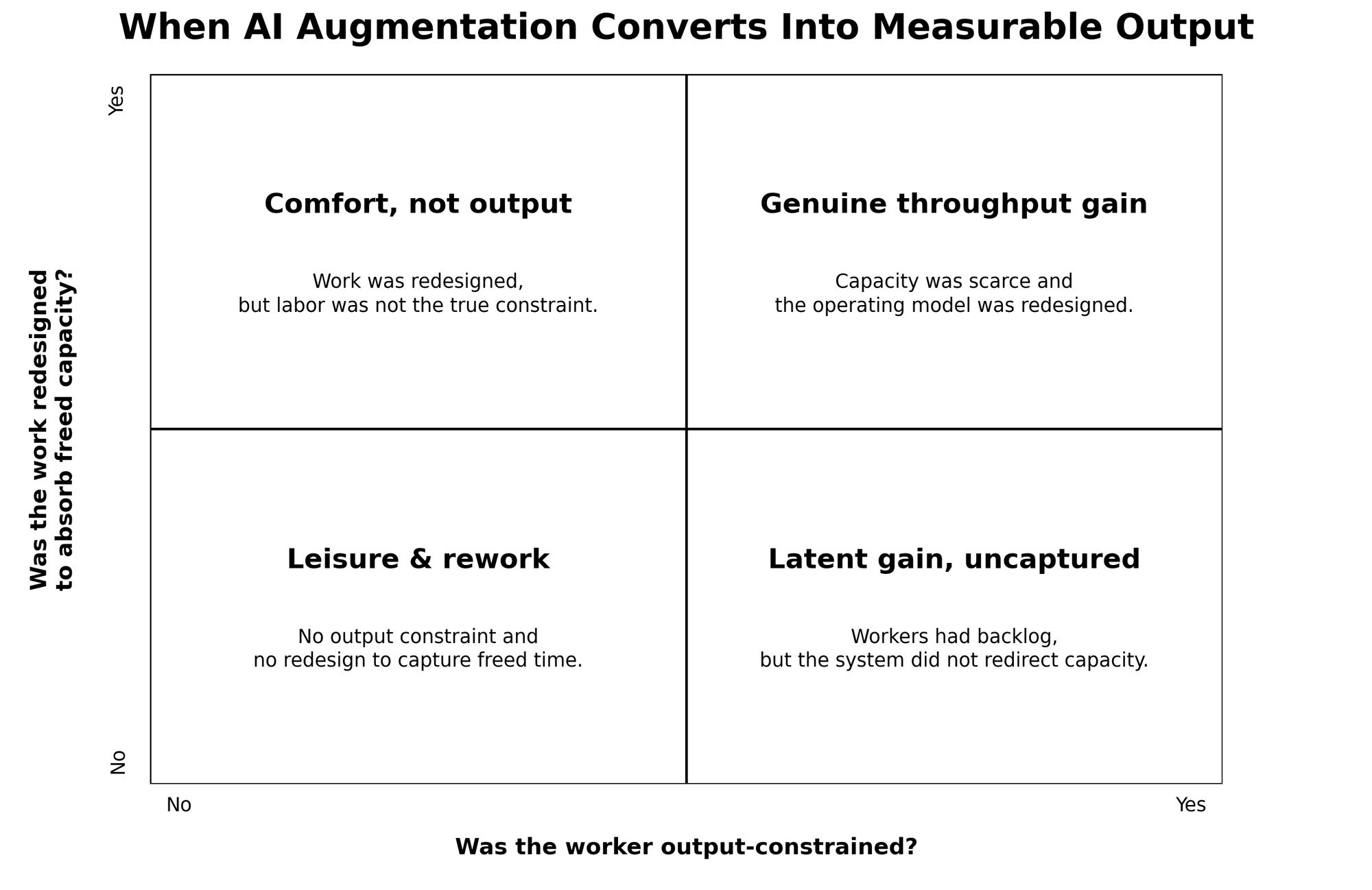
Figure 1. Augmentation produces measurable output only in the top-right quadrant—where capacity was scarce and the operating model was redesigned to use what AI returns.
The takeaway is not that augmentation is a myth. It is that augmentation acts on a worker, while output is a property of a system. Loosening one constraint inside a system governed by other constraints changes very little on its own.
Part II — The Micro Case Is Real. The Macro Case Has Gone Missing.
If you measure AI's effect at the level of a single task, the augmentation story looks vindicated. The most rigorous early field evidence comes from a study of more than 5,000 customer-support agents at a large software firm, where access to a generative-AI assistant raised issues resolved per hour by roughly 14–15% on average. The gains were strikingly uneven: novice and lower-skilled agents improved by around 34%, while the most experienced agents saw little or no benefit—and a slight decline in quality.[6] A parallel field experiment with management consultants found a similar pattern, with a crucial caveat: AI sharply lifted performance on tasks inside its capabilities and degraded it on tasks that fell outside what the researchers called the "jagged technological frontier."[7]
So at the task level, the exoskeleton is genuine—particularly for less-experienced workers, where it functions less like added strength and more like borrowed expertise. But two things complicate the leap from task to enterprise.
First, the gains don't always survive contact with real, complex work. In a 2025 randomized controlled trial—the gold-standard method, and a rare one in this field—16 experienced open-source developers completed 246 real tasks on codebases they knew intimately, with AI tools randomly permitted or forbidden. They expected AI to make them about 24% faster. Afterward, they believed it had made them about 20% faster. In fact, allowing AI made them 19% slower.[8] The perception gap is the finding that should keep executives up at night: the people closest to the work were confidently, measurably wrong about whether the tool helped. (The researchers have since begun re-running the study against late-2025 agentic tools, a useful reminder that any single snapshot dates quickly.)[9]
Second, and more damning, the micro-level gains are not showing up in the aggregate. Corporate investment in AI swelled past $250 billion in 2024, yet economists have begun resurrecting Robert Solow's 1980s productivity paradox to describe the present moment. Apollo's chief economist captured it in a line: AI is everywhere except in the macroeconomic data.[10] A February 2026 NBER study of roughly 6,000 executives across four advanced economies found most reporting little operational impact, with even AI-using executives averaging only about 1.5 hours of AI use per week.[11] Oxford Economics offered a pointed litmus test in early 2026: if AI were truly replacing labor at scale, output per remaining worker should be accelerating—and broadly, it isn't.[12] An Atlanta Fed survey went further, finding that the productivity gains executives perceived exceeded what researchers could actually measure in outcomes like revenue.[13]
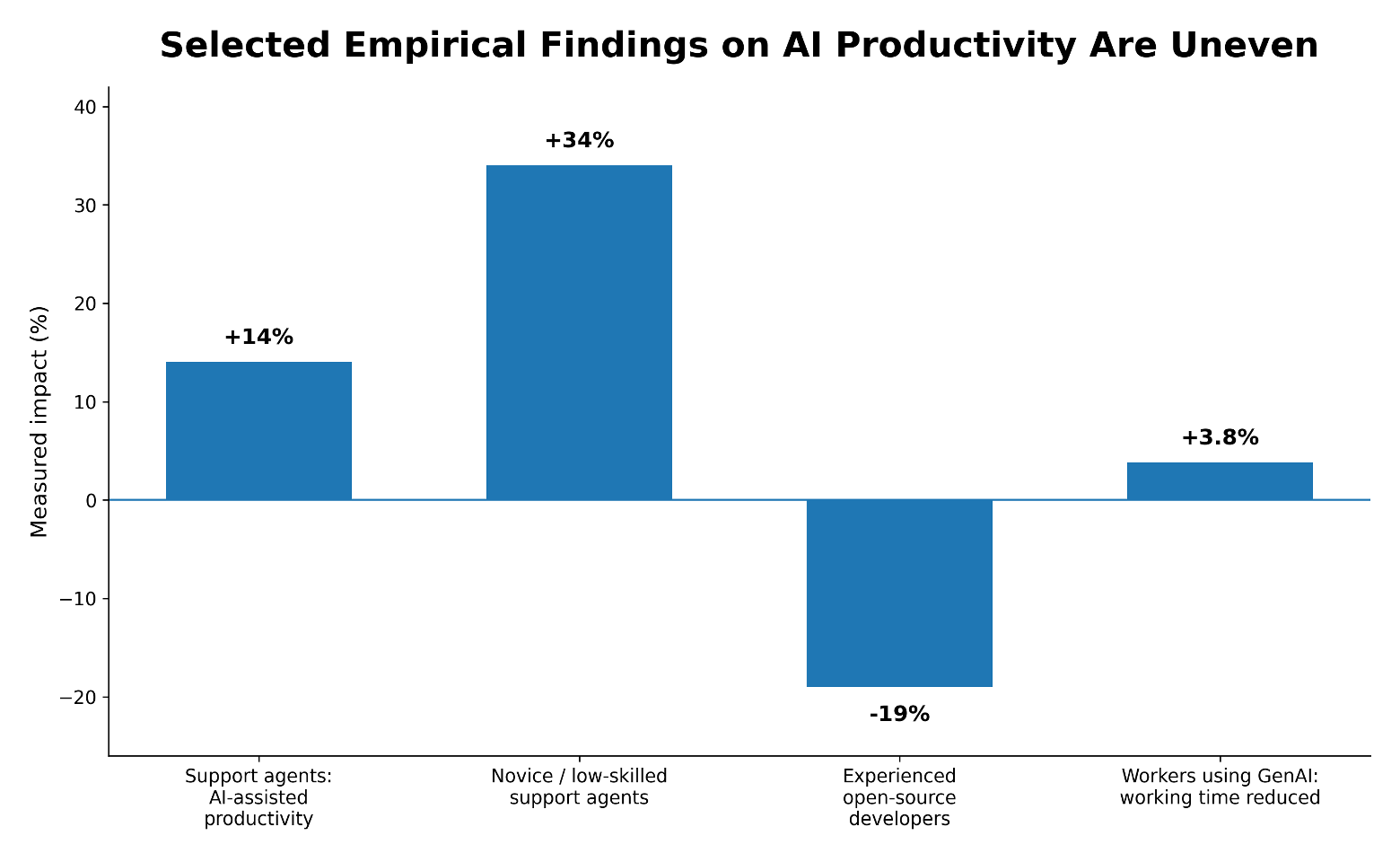
Figure 2. Selected empirical findings show that AI productivity effects are context-dependent: customer-support agents saw measured throughput gains, experienced developers in one RCT slowed down, and workers in a 2026 survey saved time without a corresponding rise in output. Sources: NBER, METR, and Suh & Oh. These are not a single benchmark.
The gap between a vindicated micro case and a missing macro case is the whole phenomenon. Something is happening to the value between the desk and the ledger. To find it, follow the time.
Part III — Where the Freed Time Actually Goes: Three Leaks
The skeptic's framing—more work or more golf?—poses a false binary. In practice, capacity freed by AI behaves like a fluid: it flows to the path of least resistance. There are three such paths, and absent deliberate design, none of them is "more valuable output."
Leak 1: On-the-job leisure. This is the golf hypothesis, and it now has direct empirical support. A February 2026 study using a representative survey of workers found that just over half used generative AI for work and that it reduced their working time by about 3.8%—but the correlation between that time saved and any change in output was near zero. The reason was explicit in the data: workers captured their efficiency gains primarily as on-the-job leisure rather than additional production.[14] Other reporting echoes the pattern, with time saved on routine tasks reappearing as more socializing and downtime rather than throughput.[15] This is Parkinson's Law operating in reverse—and it is not necessarily a scandal. Reclaimed time can show up as recovery, lower stress, and higher job satisfaction, real welfare gains that simply never touch a productivity statistic.
Leak 2: Rework and verification overhead. A second slice of the freed time is consumed putting AI's output right. A January 2026 study found that while 85% of employees saved one to seven hours a week with AI, a large share of that gain—on the order of 40%—was clawed back by rework: fixing errors, rewriting weak content, and double-checking outputs from generic tools.[16] The developer RCT showed the same mechanism in miniature, with participants spending much of their "saved" time cleaning up generated code.[17] Verification is the hidden tax of probabilistic tools, and it scales with the cost of being wrong.
Leak 3: Intensification and the ratchet. The third path is the cynic's nightmare inverted: not more golf, but more grind. A Harvard Business Review study of 200 employees at a U.S. technology firm found that time saved was frequently redirected into still more work—producing fewer breaks, longer effective hours, and higher burnout risk rather than higher net output.[18] Field accounts describe an expectation ratchet: deliver three units with AI this quarter and next quarter's quota becomes eight, with the standard resetting permanently upward.[19] Here the exoskeleton becomes a treadmill—measured output may rise, but the gain is extracted from the worker's well-being, and it is rarely sustainable.
Which leak dominates is not random, and it is not dictated by the model. The same hour returned to an employee lands as leisure, rework, or intensification depending on how the surrounding system is built: whether there is valuable work queued up, whether quality controls catch errors before the worker has to, and whether management treats reclaimed time as a dividend to be reinvested or a quota to be raised.
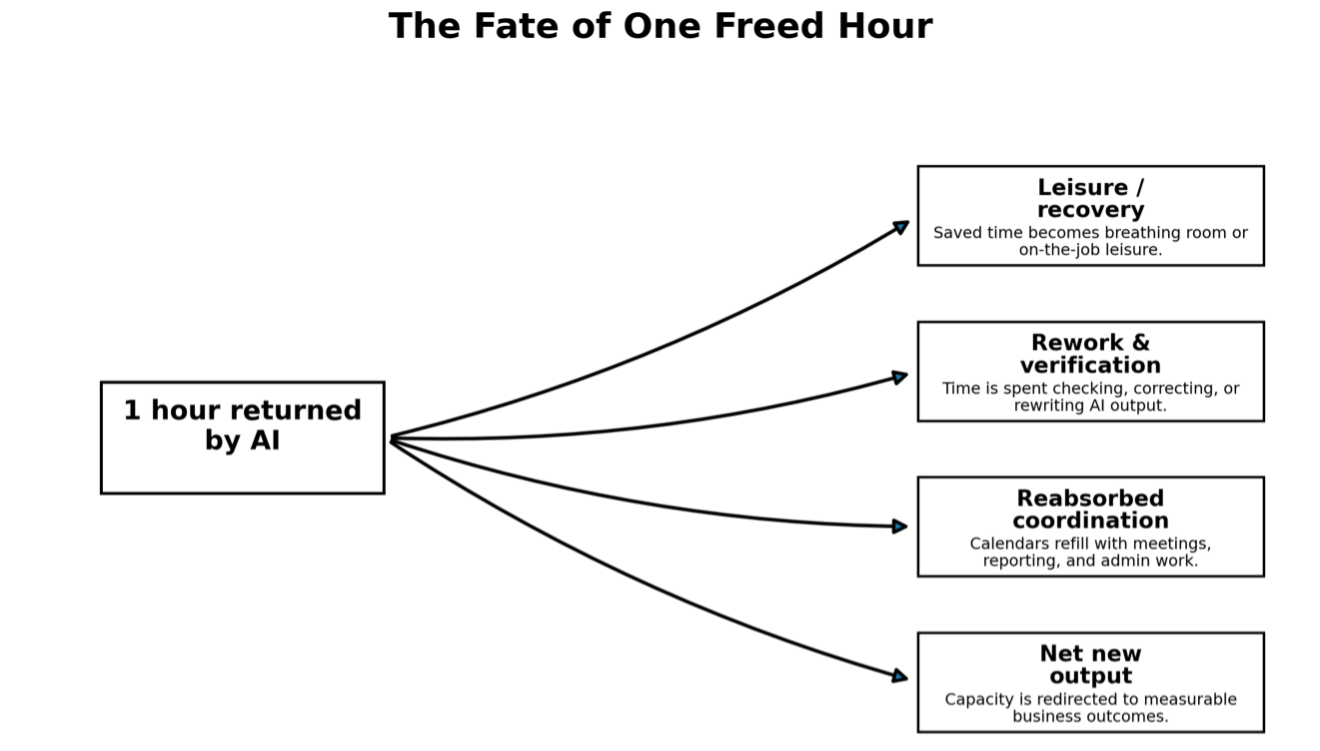
Figure 3. Conceptual flow diagram. Arrow widths are not proportional. The diagram shows the main destinations for AI-created slack unless leaders explicitly redesign work, incentives, and quality controls
It is also worth naming the quieter reason the augmentation story is so popular: it is the kinder narrative. Oxford Economics has suggested some firms are dressing routine headcount cuts up as AI-driven transformation—rebranding bad news as a strategy story for investors.[20] "We augment, we don't replace" is sometimes a genuine operating philosophy. Sometimes it is positioning.
Part IV — Turning Slack Into Output Is an Operating-Model Problem, Not a Deployment Problem
If the freed hour leaks by default, then capturing it is a design problem—and design is a leadership responsibility, not a procurement one. Buying the tool is necessary and radically insufficient. Five moves separate the organizations that will convert AI capacity into value from those that will quietly fund a more comfortable status quo.
- Decide, deliberately, what the freed time is for. The exoskeleton needs a mission. If the goal is throughput, leaders must ensure there is a queue of higher-value work ready to flow into reclaimed capacity—new analyses, more customer contact, faster cycle times—rather than assuming the queue fills itself. If the goal is partly recovery and retention, that is a legitimate choice; it simply should be made on purpose and measured as such, not discovered by accident in a burnout survey.
- Measure output, not adoption—and distrust perception. The most reliable finding across this literature is that perceived gains exceed measured ones, sometimes by a wide margin.[21] Dashboards that count licenses, logins, or "hours saved" self-reported by employees will systematically overstate value. Instrument the outcomes that actually appear on the ledger—throughput, cycle time, quality, revenue per employee—and treat the gap between perceived and measured as a managed metric in its own right.
- Engineer the demand side, not just the supply side. Classic economics offers the optimistic counterpart to Parkinson's Law: when a capability gets dramatically cheaper, demand for it can expand to consume—and exceed—the savings. Cheaper analysis can mean more questions asked, not the same questions answered with fewer people. But induced demand is a strategy, not a reflex. Capacity converts to value only where there is unmet, valuable demand for what the augmented worker now produces faster; identifying and opening that demand is the work.
- Budget for verification and govern quality at the source. Since rework is one of the three leaks, treat it as a line item. Human-in-the-loop review, evaluation and monitoring, and retrieval grounded in trustworthy sources are not compliance overhead—they are the mechanism that keeps Leak 2 from swallowing the gains. The organizations capturing the most value are reportedly those that pair the technology with investment in people, skills, and redesigned roles, rather than dropping raw tools onto unchanged workflows.[22]
- Redesign the work, then resize the team—in that order. Task-level gains aggregate into enterprise value only when processes are re-architected around the new division of labor between human and machine. That means rewriting workflows, decision rights, and quality gates before drawing conclusions about staffing. Cutting headcount first and hoping the survivors absorb the load with AI is how augmentation curdles into the intensification ratchet—and how a productivity story becomes an attrition story.
Conclusion: The Tool Is Neutral. The Operating Model Decides.
So: more work, or more golf? The defensible answer is that it is genuinely both, in proportions leadership chooses—mostly by default, and mostly without realizing a choice is being made. The augmentation narrative is not wrong so much as incomplete. It correctly observes that AI can make a worker more capable. It quietly assumes that a more capable worker is automatically a more productive organization, and that assumption fails wherever labor hours were not the binding constraint—which is most of knowledge work.
The exoskeleton is real at the level of the individual task; the field evidence on that is solid. But an exoskeleton strapped to someone who was not straining against a limit does not produce more lifting. It produces a more comfortable stance. The freed capacity then leaks—into leisure, into rework, into reabsorbed coordination—unless a leader has deliberately built the system to channel it toward something valuable.
That reframes AI value capture as exactly the kind of problem enterprises are worst at and most need to get right: not a tool to be deployed, but an operating model to be redesigned. The companies that win the next several years will not be the ones with the most AI seats. They will be the ones who answered, before signing the contract, a deceptively simple question: when we hand our people their time back, what, precisely, is it for?
Notes
[1]: MIT Sloan, "New research suggests AI is more likely to complement, not replace, human workers," March 17, 2025. https://mitsloan.mit.edu/press/new-mit-sloan-research-suggests-ai-more-likely-to-complement-not-replace-human-workers
[2]: Coverage of the Semafor World Economy conference exchange on augmentation versus displacement, April 2026. https://letsdatascience.com/news/ceos-bet-ai-will-augment-not-replace-workers-05966f45
[3]: C. Northcote Parkinson, "Parkinson's Law," The Economist, 1955; overview via Wikipedia. https://en.wikipedia.org/wiki/Parkinson%27s_law
[4]: Summary of the 1967 Organizational Behavior and Human Performance experiment on time allowance and task duration. https://scienceinsights.org/parkinsons-law-explained-work-expands-to-fill-time/ [5]: Analysis of Parkinson's Law in knowledge work and how unused time is reabsorbed, October 2025. https://www.duperrin.com/english/2025/10/13/parkinson-law-productivity/
[6]: Erik Brynjolfsson, Danielle Li & Lindsey Raymond, "Generative AI at Work," Quarterly Journal of Economics 140(2), May 2025 (NBER WP 31161). https://academic.oup.com/qje/article/140/2/889/7990658
[7]: Fabrizio Dell'Acqua et al., "Navigating the Jagged Technological Frontier," Organization Science, 2026. https://pubsonline.informs.org/doi/10.1287/orsc.2025.21838
[8]: Joel Becker, Nate Rush, Elizabeth Barnes & David Rein (METR), "Measuring the Impact of Early-2025 AI on Experienced Open-Source Developer Productivity," July 2025 (arXiv:2507.09089). https://metr.org/blog/2025-07-10-early-2025-ai-experienced-os-dev-study/
[9]: METR, "We are changing our developer productivity experiment design," February 24, 2026. https://metr.org/blog/2026-02-24-uplift-update/
[10]: Fortune, "Thousands of CEOs admit AI had no impact on employment or productivity," April 20, 2026 (citing Apollo's Torsten Slok and 2024 AI investment figures). https://fortune.com/article/why-do-thousands-of-ceos-believe-ai-not-having-impact-productivity-employment-study/
[11]: NBER executive-survey findings reported in Fortune, April 2026 (see note 10).
[12]: Fortune, "AI layoffs are looking more and more like corporate fiction," January 7, 2026 (Oxford Economics briefing). https://fortune.com/2026/01/07/ai-layoffs-convenient-corporate-fiction-true-false-oxford-economics-productivity/
[13]: Fortune, "Why AI is raising worker productivity but not making the economy more efficient," May 27, 2026 (Atlanta Fed survey; HBR and LSE studies). https://fortune.com/2026/05/27/ai-productivity-internet-boom-solow-paradox/
[14]: Donghyun Suh & Samil Oh, "Generative AI and the Reallocation of Time: Productivity, Leisure, and Fulfilling Work," February 2026 (arXiv:2602.12695). https://arxiv.org/pdf/2602.12695
[15]: Fortune, April 2026 (time saved reappearing as leisure; see note 10).
[16]: Workday, "Beyond Productivity: Measuring the Real Value of AI," January 14, 2026. https://www.barchart.com/story/news/37034540/new-workday-research-companies-are-leaving-ai-gains-on-the-table
[17]: METR, July 2025 (developers cleaning up generated code; see note 8). [18]: Harvard Business Review study of 200 employees at a U.S. technology company, reported in Fortune, May 2026 (see note 13).
[19]: Account of AI-driven work intensification and the "expectation ratchet," February 2026. https://medium.com/ai-analytics-diaries/ai-was-meant-to-free-workers-but-startup-employees-are-working-12-hour-days-7606ea74e82c
[20]: Oxford Economics via Fortune, January 2026 (layoffs rebranded as AI transformation; see note 12).
[21]: Perception-versus-measurement gap documented in both the METR RCT (note 8) and the Atlanta Fed survey (note 13).
[22]: Workday, January 2026 (highest-value organizations reinvest saved time into skills and role redesign; see note 16).